Welcome!

Welcome to my world of pipes. On these pages you will see some of what goes on in my workshop. A bit of work-in-progress, mess-ups (they do happen!) and also some other pipe-related posts.
I love talking about and discussing pipes, so feel free to contact me at charl.chillfactor@gmail.com.
Should you wish to have a look at my pipes, please drop in at my website (http://goussardpipes.com/).


February 24, 2014

A coming of age

In my first year at varsity, my room mate smoked. I did not. In fact, I hated the smell of smoke. There was a constant moaning and groaning from my side regarding his smoking in the room.
One afternoon, we were chatting along, when I told him that I will never smoke cigarettes (ha!), because it stinks. The only smoking I might do, I declared, might be a pipe, because it least that smells nice!
So off my enterprising friend Andreas went and he got himself a pipe, thinking that he will then be able to smoke in the room without any complaints. It wasn't long before I tried a couple of puffs and the infatuation started!
My dear friend came visiting over the weekend and much too my surprise, he pulled The Pipe out! The very first one that he bought and we both smoked.
It is a no name basket pipe, of course stamped "real briar" (and that only) with crackled and pitted varnish finish. The bowl looks like crap, the tenon have paper turned around it to keep it in the mortise and the stem has been superglued where it broke in two.
Does it have any monetary value? No way! But that little crappy pipe is worth much more to me than my whole collection, I'll give 10 Goussard Pipes for that pipe to keep ownership of either me or my friend.
And the best of all?
It was exactly 21 years ago we met and started smoking that pipe together, we're still doing it and we probably will be doing it still in another 21 years time!

February 10, 2014

First of the Lithuanian Specials

Here are the first two of the lot of  pipes that I started while visiting the in-laws in Lithuania.

The bottom one is in the Scoop fashion, with the top one a chubby apple. On the apple I tried a new contrast staining technique, which I'm so far quite impressed with. The grain of course also helped!
They just need to be waxed and polished and then they'll be ready for school!

January 8, 2014

Pipemaking in Lithuania

If you're a pipemaker, you'll find a way to make pipes anywhere. Luckily for me, my father in law is a carpenter by trade, which helps! We are in Lithuania visiting the in-laws for the holidays and I wanted to be able to make some dust while being here.
 I was very surprised (and happy!) to find this machine here in his shop. Its function is actually for mortising. The table you see in the front can move up and down, forward and back and from left to right.
 The three jaw chuck is of course very convenient! With the table moved forward, I can use it for sanding with a disc. I've also tried to drill both stummels and stems with it, just to see, but the speed is unfortunately way too high. There is no specs on the motor, but I reckon rpm must be in the 3000 range. Luckily, like in most woodwork shops, there also is a drillpress, with which I can do the drilling.
 This is a couple of bits and bobs that I brought along. Different sizes and types of rodstock, bits, bamboo, sanding discs, a file or two and of course some blocks.
And here are the first 2 babies that I got going.

December 2, 2013

How I do a shank ring

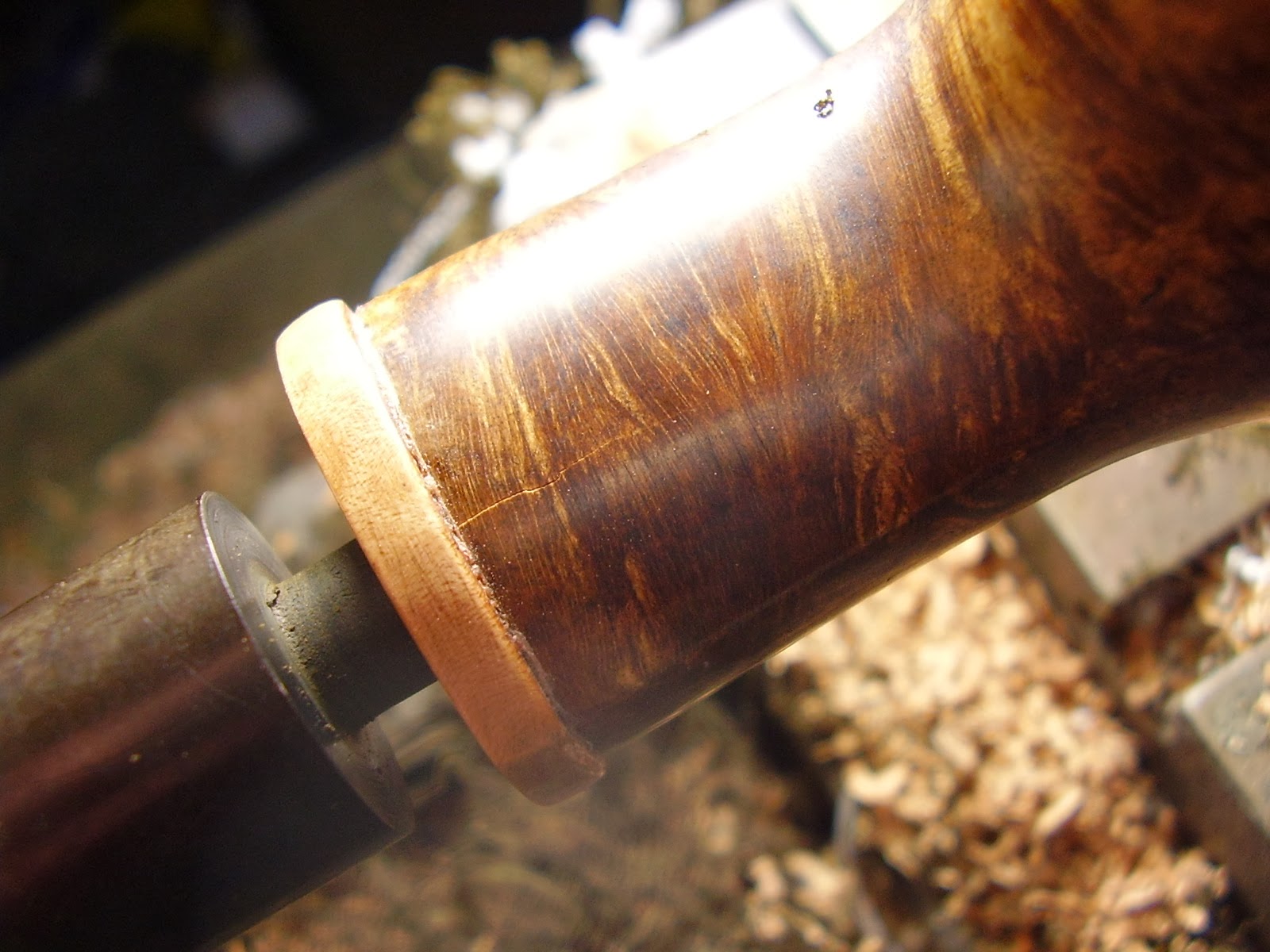
A while ago somebody was interested in how stem inserts and end caps are done. Seeing that at that stage I was busy with a pipe that was going to get a shank ring, I thought I might as well put a couple of photos together and show how I do it.
 In this instance, the pipe was shaped first and the bowl, airway and mortise drilled thereafter, but it is also possible to do it the conventional way (by drilling and then shaping). The particular stummel has been shaped in rough on a 24 grit disc. First, with the pipe fitted onto a pin gauge, a small tenon is turned on the shank, slightly bigger than the mortise size. I like to have only briar and ebonite (or in some instances, acrylic) in contact with the smoke channel, although some other makers prefer not to see any briar on the shank face when making an end cap.
 Then I'll face both sides of the material that is going to be used as end cap to the thickness wanted. This is then drilled to about a one millimeter depth with a forstner bit that is slightly smaller than the height of the shank when seen from the side. This have the advantage that, especially when using wood, a little bit of warping will not have any effect on the fit of the stem. Thereafter I will use a bit with the  same diameter as the tenon that was turned on the stummel, to drill through the ring. For now, this ring will be kept to the side.
An off-cut piece of briar is then faced and drilled with the same bit and with a tiny bit of CA glue on the tenon, glued to the shank.
 The reason for using this off-cut is to ensure that the shank lines are kept true, without the chance of rounding the shank edge when sanding through the grits. I finalize the shape on the discsander with 60 and 100 grit discs and then go onto sanding by hand. The off cut will stay on until the pipe has been sanded and stained to completion, with only buffing and polish still to come.
 Now the off cut piece of briar can be removed. This I do by very carefully using a small vice to chuck the off cut only and then with a sharp quick twist of the stummel, get the off cut to come loose.
The secret is to use only enough CA glue to keep the piece in place, but not too much so that you'll struggle to get it off or worse, break the shank!
 Now the shank ring is dry fittted into place and shaped to the desired size and with the desired radius. When I'm happy that it is as I want it to be, it is sanded to 400 or 600 grit (depending on material).
The next step is to epoxy it into place. A generous amount of epoxy is put on both the briar shank face and the briar tenon, the end cap is slipped over and held in place for a minute until adhesion starts. All the excess glue will pop out from between the shank face and the shank ring, but do not worry and do not touch or wipe this. Take the backside of a match and every now and then stir a bit though the epoxy that hasn't been used. In a couple of minutes you'll notice that this becomes harder when it starts to set. That is the window of opportunity you need. Take a toothpick and carefully start removing the excess epoxy. If you're timing is right, it will peel off easily. There will be no glue marks left on the stummel or shank ring and no visible glue line between the two.
Normally I will start on the stem now, until completed, then stamp the pipe and polish and wax.



November 17, 2013

A recent blast

This is a blast that I finished last week and I'm pretty stoked with how it turned out.
Here is the pipe just after blasting:
 And here is the finished pipe:
 Isn't briar such a wonderful  amazing wood to be able to work with?

October 18, 2013

A week ago..

This is a week ago..
And it still looks the same! I just hate it when work gets in the way of pipemaking!

October 4, 2013

Vladivostok!

I was working on this beauty this morning. With the stummel basically completed (just wax and polish to follow), I started on the stem.
 Being a bit impatient, I forced the tenon into the mortise and heard the faintest sound of wood going "crack".
We learn from our mistakes, I suppose...